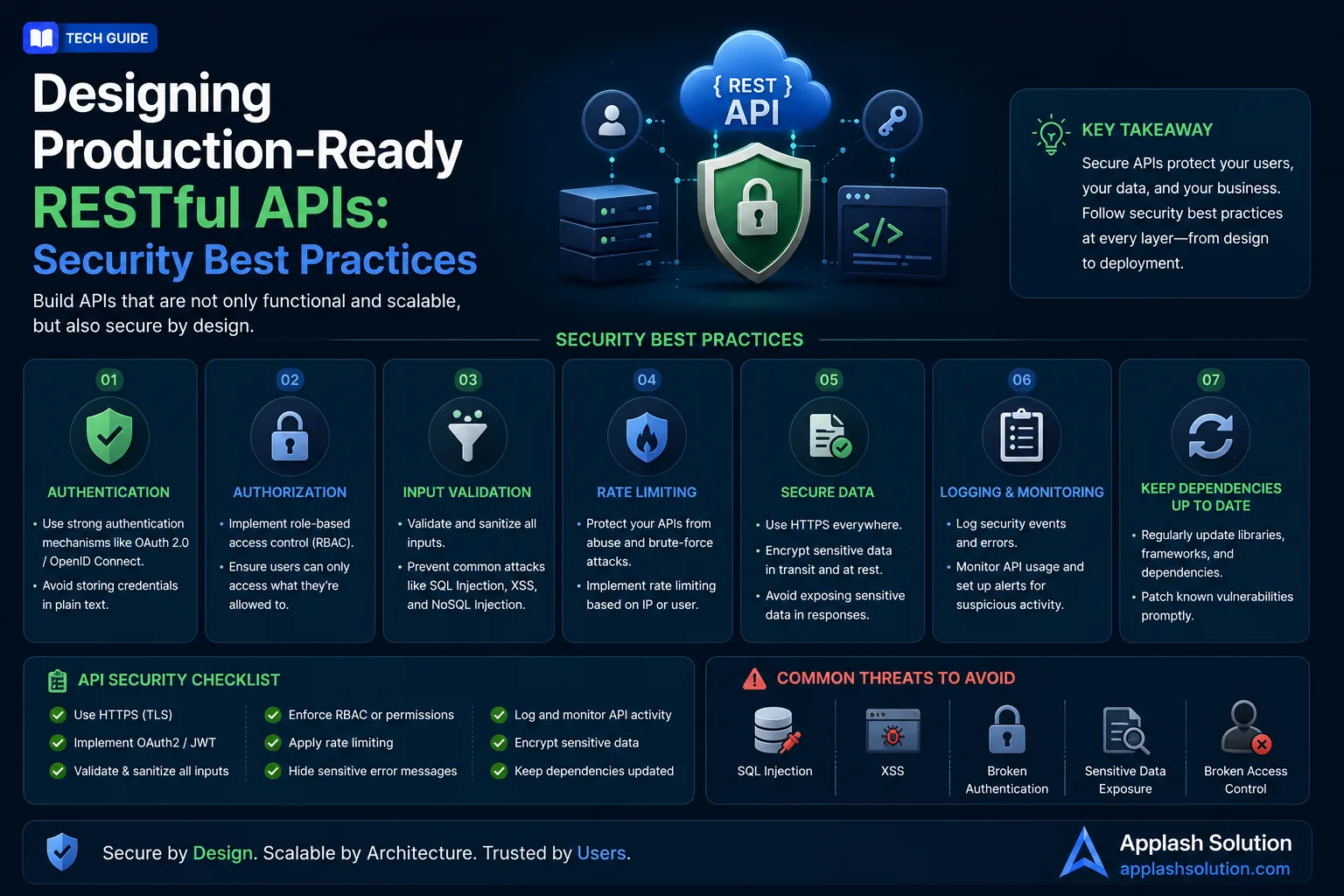
Designing Production-Ready RESTful APIs: Authentication, Rate Limiting, and Security Best Practices
When building application program interfaces (APIs) for enterprise systems, engineering requirements extend far beyond simple CRUD (Create, Read, Update, Delete) resource routes. A production ready RESTful API must be resilient against traffic spikes, secure by design, and architected to mitigate malicious exploitation.
Securing a modern backend architecture requires establishing a defense-in-depth approach across three critical pillars: robust authentication, defensive rate limiting, and standard security best practices.
1. Authentication & Authorization: Choosing the Right Layer
Authentication confirms an identity; authorization dictates their system boundaries. Production systems typically utilize one of two core structural paradigms:
Statefully Managed Sessions (Opaque Tokens)
The client receives a random, unreadable string that references an index entry on the backend server database or a distributed cache (like Redis).
Pros: Instant, global revocation control. If an account is compromised, destroying the database session record immediately boots the user off.
Cons: Introduces a state dependency. Every incoming network call requires a database lookup, creating an operational bottleneck at scale.
Stateless Tokens (JSON Web Tokens - JWT)
The token contains the payload (claims) and signature encoded straight into a cryptographically signed cryptographic string.
Pros: Completely stateless. The resource server decodes and validates the signature using a public/private key pair without hitting a database.
Cons: Hard to invalidate before expiration. To handle this securely, implement short-lived Access Tokens (e.g., 15 minutes) paired with stateful, long-lived Refresh Tokens stored securely inside an
HttpOnly, Secure, SameSite=Strictcookie wrapper.
2. Implementing Resilient Rate Limiting
Without rate limiting, your API infrastructure is vulnerable to Denial of Service (DoS) attacks, brute-force entry, and resource starvation from unoptimized client loops.
The industry-standard choice for production APIs is the Token Bucket Algorithm.
The Architectural Blueprint:
The Mechanics: A bucket holds a maximum number of tokens ($B$). Each request consumes exactly one token. The system refills the bucket with tokens at a sustainable, fixed time cadence ($r$) up to the maximum capacity. If the bucket runs dry, incoming calls are rejected immediately with an HTTP status code of
429 Too Many Requests.Where to Deploy: Place this layer at your edge gateway (e.g., Nginx, AWS API Gateway, or Cloudflare Workers) rather than processing it deep inside your application thread pool. This drops malicious requests before they consume precious database connection pools.
3. The Core OWASP Security Checklist
To protect against structural threats, ensure your development pipeline implements these non-negotiable guards:
Prevent BOLA (Broken Object Level Authorization): Never assume an authenticated user has permission to view an asset just because they know its ID. Always validate ownership properties before returning data:
Enforce Strict Input Validation: Sanitize and validate every incoming string payload against a rigid JSON schema. Reject unstructured type inputs early to protect against SQL injections and remote code execution vulnerabilities.
Obfuscate Auto-Incrementing IDs: Never expose structural databases keys (e.g.,
/api/v1/users/1) to the public. Use cryptographically secure identifiers like UUIDv7 or Hashids. This masks your total data volume and stops attackers from scraping records using simple incremental loops.
Work with Applash
Have a process you want to automate?
Tell us how your business works today. A senior person reads every message and replies within one business day.