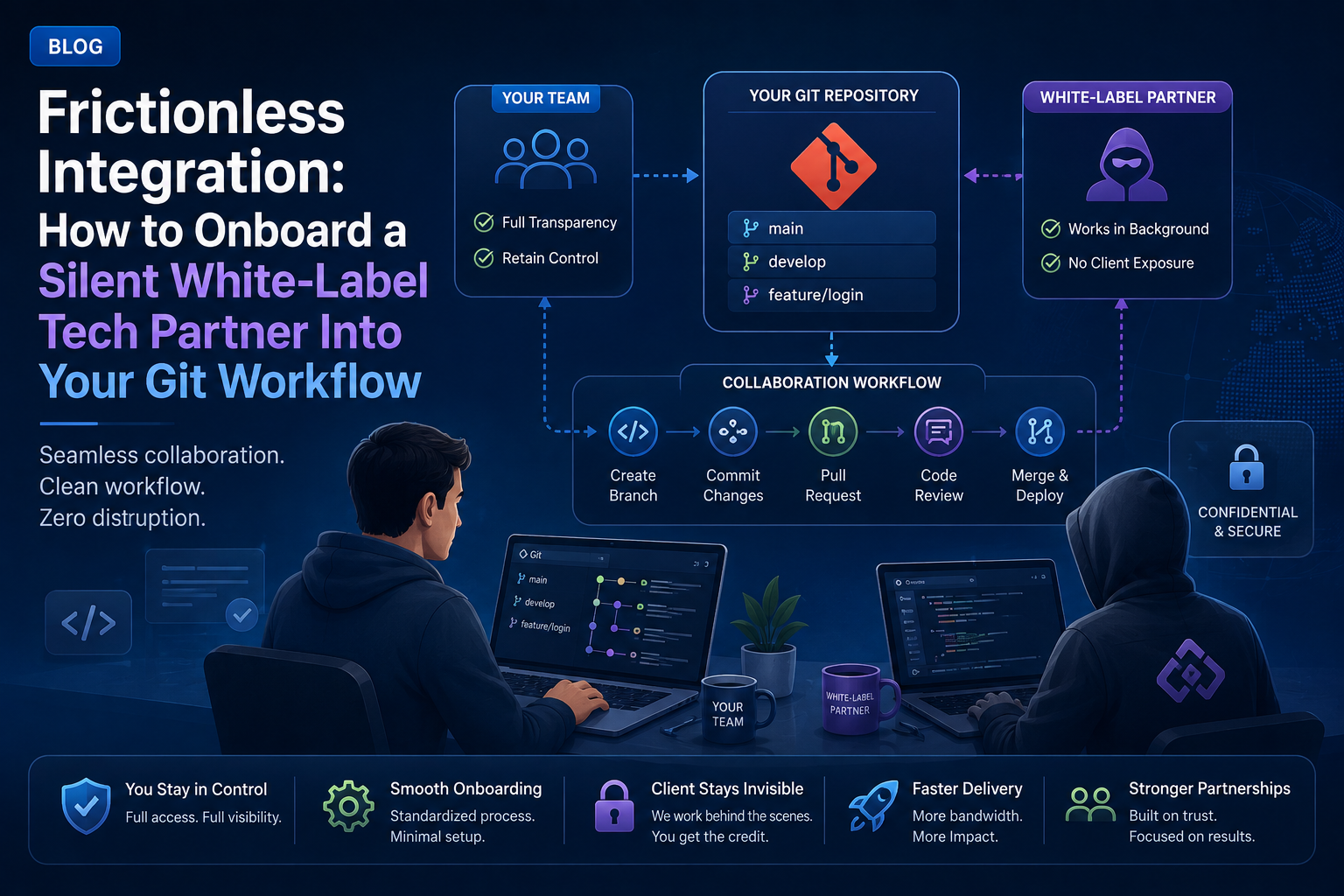
Partnering with an external white-label engineering team can unlock unprecedented scale for your agency. But if your onboarding process consists of dumping a zip file of specs and granting unrestricted root access to your cloud infrastructure, you are setting yourself up for friction, security risks, and communication breakdown.
To maintain speed and quality, your external dev partner should feel like a frictionless extension of your existing team - operating quietly within your established Git workflows, ticketing systems, and deployment pipelines.
Here is a step-by-step framework to seamlessly onboard a silent technical partner into your development pipeline without disrupting your daily operations.
Phase 1: Access Control & Security Architecture
Never give third-party developers administrative access to your core infrastructure on day one. Practice the Principle of Least Privilege (PoLP).
Identity & Access Management (IAM): Issue developer credentials tied to company-controlled emails or enterprise SSO (e.g., Google Workspace).
Granular Repository Permissions: Grant write access only to feature branches or forks, restricting direct pushes to
mainorproduction.Secrets Management: Use environment managers like Vault, Doppler, or GitHub Secrets so third-party developers never see live API keys or production database credentials.
Phase 2: Standardizing the Git Workflow
A standardized branching strategy ensures that external commits blend seamlessly into your codebase.
[Feature Branch (Partner Dev)] --> [Pull Request] --> [Automated CI/CD & Code Review (Agency Lead)] --> [Merge to Main]
Adopt GitFork or Feature Branching: Require all external work to occur on feature branches (
feature/jira-123-user-auth).Enforce Branch Protection Rules: Mandate that no code merges into
stagingormainwithout passing automated unit tests and getting explicit approval from your internal Tech Lead.Automate Formatting & Linting: Implement pre-commit hooks (e.g., Husky, ESLint, Prettier) to force uniform code formatting across all developers automatically.
Phase 3: Project Tracking & "Silent" Communication
To maintain a white-label experience, communication must be structured and streamlined.
Jira / Linear Alignment: Map tasks directly to clear acceptance criteria. Use strict status transitions (e.g., To Do -> In Development -> Internal PR Review -> QA -> Done).
Asynchronous Updates: Require daily async standups via Slack/Teams channels or Jira comments, keeping direct client communication exclusively with your in-house project managers.
Checklist: Frictionless Onboarding Blueprint
Access Provisions: Issue scoped email/SSO accounts and VPN access if required.
Repository Setup: Add partner devs to designated Git branches with strict branch protection rules enabled.
Environment Parity: Provide Dockerized local dev environments so setup takes hours, not days.
Secrets Delivery: Provision staging environment keys via a secure secrets manager.
CI/CD Integration: Verify automated test runners pass on new pull requests automatically.Review Protocol: Assign an internal Tech Lead to manage pull request approvals.
Final Thoughts: Seamless integration isn't magic; it's sound system design. By establishing clear access boundaries, enforcing standard Git hygiene, and utilizing automated CI/CD tools, your agency can plug in white-label engineering capacity smoothly and deliver builds faster than ever before.